
Newsletter Subscribe
Enter your email address below and subscribe to our newsletter

 ByJohn A
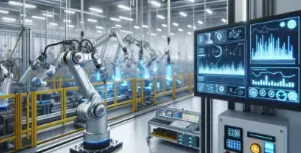
AI is reshaping production by aligning capacity, materials, and schedules with demand through real-time data, predictive analytics, and optimization. It enables precise forecasting, autonomous adjustments, and scalable coordination, anchored in robust data governance. Real-time quality monitoring and predictive maintenance cut defects and downtime via anomaly detection and root-cause analysis. AI-enabled automation and robotics support adaptive, risk-aware decisions, while ROI and adoption metrics frame continuous improvement—raising questions that demand further scrutiny as systems evolve.
AI-driven production planning leverages real-time data, predictive analytics, and optimization algorithms to align capacity, materials, and schedules with demand. The approach emphasizes precision forecasting and supply alignment, reducing variability and accelerating decision cycles. By modeling constraints, it reveals optimal trade-offs across factories, inventory, and throughput, enabling autonomous adjustments and scalable coordination while preserving freedom to pursue innovative, resilient production ecosystems.
Real-time quality monitoring and predictive maintenance leverage continuous sensor data, advanced analytics, and optimized maintenance schedules to minimize defects and unplanned downtime.
The approach emphasizes unsupervised optimization of anomaly detection, root-cause isolation, and proactive fault prognosis, enabling lean, resilient operations.
Decision-making remains data-driven and observable, aligning maintenance timing with production needs while preserving autonomy and freedom in system design.
See also: diyworld4life
ai enabled automation unlocks adaptive production with disciplined risk-aware autonomy and freedom-respecting decision processes.
Measuring impact in modern production requires a disciplined framework that translates observed improvements in automation and robotics into concrete financial and operational outcomes. ROI models quantify capital and operating savings, while metrics track throughput, quality, and cycle times. Data governance and model governance ensure trustworthy inputs; cross functional alignment and change management sustain adoption, surfacing optimization opportunities and clarifying accountability across the system.
AI solutions show partial scalability across lines; scalability challenges persist. Cross line deployment often demands standardized data, modular models, and centralized governance to optimize performance, reduce variance, and preserve autonomy, enabling freedom-focused operations without sacrificing system-wide efficiency.
Data privacy implications in ai-enabled factories center on data ownership and model governance, balancing transparency with performance. The approach emphasizes centralized policy, auditable data provenance, access controls, and continuous risk optimization to preserve autonomy while ensuring compliant operations.
The metaphorical bridge of AI skills gaps signals required workforce retraining, as automation reallocates tasks. Data-driven, optimization-focused analysis shows AI skills gaps narrowing with targeted programs, enabling resilient, freedom-seeking workers to adapt and sustain high-performance production systems.
AI energy reductions extend beyond downtime via optimized equipment loads, predictive maintenance, and supply-chain alignment, boosting production efficiency through data-driven, systems-oriented decisions that minimize waste; the approach offers freedom through lean energy governance and measurable performance gains.
rollout timelines vary by organization, but phased pilots accelerate cross‑system rollout; governance and legacy integration are critical. The approach emphasizes data readiness, modular deployment, and continuous optimization to balance risk, cost, and freedom across legacy environments.
AI is steering production toward unprecedented synchronization: demand forecasts tighten to capacity, and real-time signals continuously recalibrate schedules. Quality, maintenance, and robotics operate as an integrated loop, revealing hidden inefficiencies and accelerating recovery from disruption. Yet the full payoff hinges on governance, data integrity, and cross-functional alignment. As models learn and operators adapt, the next decisive move—where optimization converges with resilience—remains just out of reach, waiting for the next data-driven breakthrough to unlock it. The suspense is the roadmap.




[…] See also: How AI Is Transforming Production Processes […]